How Dealers Can Win Back $12,398 per Lost Customer
Ted Ings · Founder, Fixed Ops Roundtable
With profit margins squeezed in both new and used vehicles, dealers are realizing that fixed ops is their most reliable profit center. But they also face a sobering reality: while overall fixed ops revenue has grown, dealerships are capturing a shrinking piece of a growing pie.
While vehicle owners are keeping their cars longer than ever, they're increasingly turning to independent shops and quick lube centers. Dealership share of total service visits has fallen from 33% in 2018 to just 29% in 2025, with the steepest losses coming from vehicles five years old and newer.
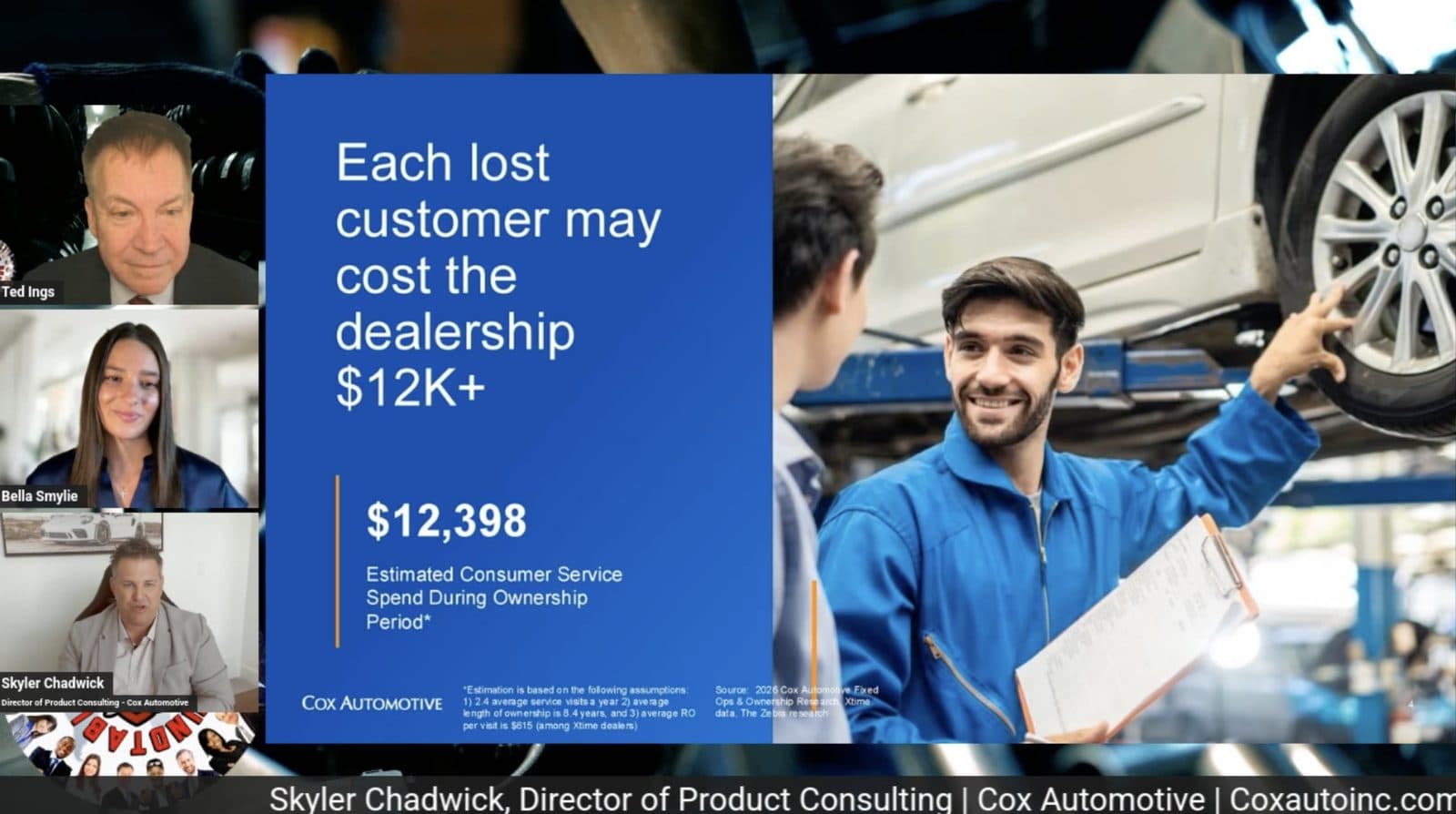
What does that translate to in terms of dollars? During a typical ownership period, the average consumer spends an estimated $12,398 on service and maintenance. That's significant revenue walking out the door every time a customer doesn't return!
I recently sat down with Skyler Chadwick, Director of Product Consulting at Cox Automotive, along with Fixed Ops Roundtable intern Bella Smylie, to break down the eye-opening findings from the 2025 Cox Automotive Fixed Ops and Ownership Study. This is one conversation every service director, fixed ops director, and general manager needs to see.
Key takeaways
- Dealership share of service visits fell from 33% in 2018 to 29% in 2025, with the steepest losses on vehicles five years old and newer.
- The average owner spends an estimated $12,398 on service and maintenance over a typical ownership period.
- Customers who return for service are far more likely to buy their next vehicle from the same store: 74% versus 44%.
- Repair orders sent with photos and videos average $640, versus $410 without them.
Customer Retention Gap Is Costing You Twice
Early connection with the service department is critical, yet the study reveals a massive gap: while 80% of new buyers want to service at the selling dealership, only 25% are introduced to the service department during the sales process, and just 23% leave with their first service appointment already scheduled.
After the two-year mark, 42% of consumers start considering general repair shops instead of returning to the dealership.
This loss hits dealers twice. In addition to relinquishing a big chunk of that $12,398 lifetime service spend, buyers who return for service are nearly twice as likely to purchase their next vehicle from the same store—74% versus only 44% for those who don't return.
What's driving this defection? Surprisingly, it's price perception—not actual pricing. The average customer spend at a general repair shop is $275, versus an average spend of $261 at the dealership. Yet many customers still believe dealers are more expensive.
"Dealers need to educate customers that pricing is competitive!" says Chadwick. "Pricing transparency is still a major problem. I recently called several dealers for an oil change quote on my truck, and not one could give me a quote over the phone."
Chadwick points out that in a service scheduler, two things will immediately deflect customers: unclear pricing and long wait times. According to the study, 55% of vehicle owners want to be able to compare prices of services online.
"Give customers a price!" Chadwick says. "General repair shops are posting prices, and customers are using AI to research and compare pricing."
When Smylie asked about the biggest missed opportunity in service, Chadwick replied, "How do we keep this customer in the ecosystem? We must do a better job of communicating, because once customers are in, they stay—a staggering 89% of consumers who service at a dealership consider coming back."
Acquisition Opportunities Hit the Skids
Another major opportunity gap lies in service lane vehicle acquisition. While 33% of customers are highly interested in receiving a trade-in value during a service visit, only 14% get one.
Customers typically start thinking about trading in their vehicle when a repair estimate reaches $3,195. Chadwick recommends dealers proactively review every service appointment before the customer arrives and ask, "Is this a vehicle we want? Is it a strategic fit?" Don't wait for the customer to bring it up.
MPI Videos Deliver Massive ROI
One of the clearest opportunities uncovered in the study is the power of high-quality multi-point inspection (MPI) videos. When dealers send photos and videos of recommended service along with the repair order, the average RO spend jumps to $640—compared to only $410 when no visuals are provided. That's a $230 increase per RO simply by showing the customer what the technician sees.
Chadwick put it plainly. "If you think about the advantages a dealership has—an OEM-certified technician explaining the vehicle's condition with photos and videos and guaranteeing OEM parts—that's a huge differentiator that independents can't match."
Top Customer Frustrations
The study found that 45% of dealership service customers report some level of frustration during their visit. The top three complaints were length of visit, pricing transparency, and feeling pushed on additional services.
"The number one frustration is that it takes too long," says Chadwick. "We need faster parts and service quotes, faster throughput." High-performing dealerships are solving this with better processes, starting with online scheduling—81% of high performers offer it versus 72% of others.
Pricing transparency ranks second, with 13% of customers experiencing opacity and 12% seeing prices exceed the original estimate. High performers close this gap with electronic estimates, providing near-instant quotes.
The third frustration (13%) is feeling pressured on upsells. MPI videos are the best solution here. An impressive 64% of high-performing dealerships send ROs with photos and videos, and customers who receive them are 49% more likely to approve the estimate and 45% more likely to recommend the dealership.
"Start with photos and videos, then layer in online scheduling, electronic estimates, and mobile check-in to directly address the top customer frustrations," Chadwick recommends.
The study reveals more secrets from high-performing fixed ops departments:
- 44% track RO performance closely
- 42% implement service process efficiencies
- 42% offer financing options for service work
- 86% have a formal process for acquiring inventory through the service lane
These dealerships aren't just maintaining the status quo—they're actively turning service into a powerful profit center and customer retention engine.
"This is the year for fixed ops!" Chadwick says in his closing message. "When new and used margins are shrinking, we have to look at fixed operations as the area that will help dealers survive and thrive."
Watch the full interview with Skyler Chadwick on Fixed Ops Roundtable TV. This is an important conversation with actionable tips on how to grow fixed ops revenue and customer retention in 2026.